
Tags
Gaza, Iran, Israel, Middle East, Palestine, regional hegemony, US
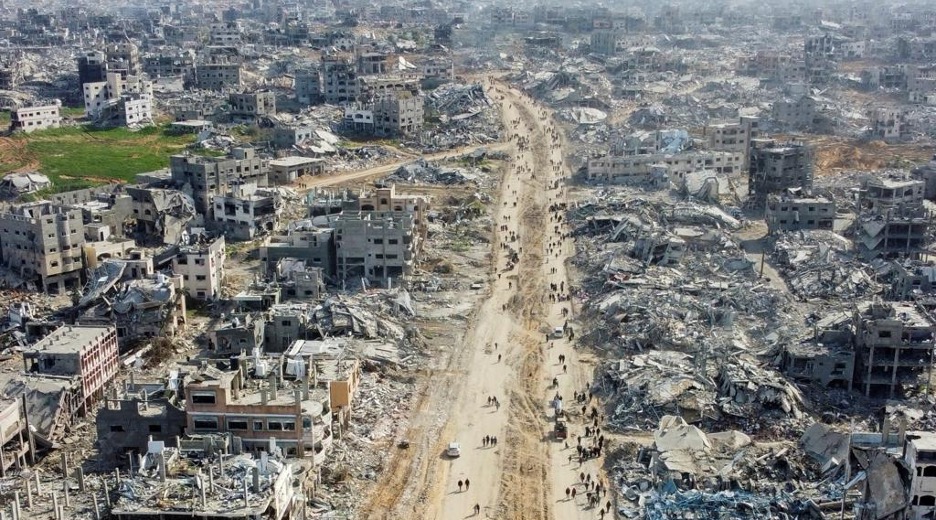
[1] An uneasy truce may exist between the United States and Iran, but peace in the Middle East remains elusive. Israel’s recurring wars with its neighbours have kept the region in a state of chronic tension for decades.
[2] The cumulative toll is staggering. In Gaza, more than 72,000 people have been killed and entire neighbourhoods reduced to rubble. In the West Bank, Palestinians face killings, imprisonment, and dispossession — homes torched, land seized. Lebanon is under invasion, its cities battered and millions displaced. In Syria, airstrikes devastate towns and villages. In Iran, neighbourhoods lie shattered, communities plunged into mourning. Across the region, Israel’s actions have wrought immense death and destruction.
[3] Prime Minister Netanyahu insists that Israel is acting in self-defence, but that claim grows thinner by the day. Israel is no longer a beleaguered state fighting for survival against overwhelming odds. It is, by any objective measure, the most powerful military force in the region — backed decisively by the diplomatic, financial, and military weight of the United States. Its adversaries, fragmented and comparatively weak, pose no existential threat.
[4] Under Netanyahu, Israel is moving towards regional hegemony. The objective is no longer confined to countering threats, but to reshaping the Middle East decisively in Israel’s favour. Pretexts are readily seized upon to launch wars that weaken neighbours or crush them into submission.
[5] The methods used to pursue these aims are deeply troubling. Targeted killings and arrests extend beyond combatants to include politicians, doctors, journalists, teachers, and other community leaders — eroding the social fabric. Entire neighbourhoods are levelled, essential infrastructure systematically crippled, and even deprivation is used as a tool of control. These are not incidental by-products of conflict but elements of a broader strategy of total war against its neighbours.
[6] Nowhere is this strategy more starkly evident than in Gaza and the West Bank, where an unprecedented campaign of ethnic cleansing appears to be underway. Much of Gaza has been reduced to rubble; civilians are killed in plain sight, and survivors face starvation and disease by design. A growing number of observers — including legal scholars and human rights organisations — have characterised these actions as amounting to genocide, with widespread war crimes documented. Notably, Israeli politicians themselves have made statements that reinforce these concerns.
[7] The urgent need now is for a fundamental reset: a new regional framework grounded in mutual security, accountability, and adherence to international law. At its core must be a clear recognition that instability stems both from the unresolved Palestinian question and from Israel’s pursuit of regional hegemony. Any credible effort must address both — advancing a just resolution for Palestinians while curbing actions that perpetuate conflict.
[8] The major powers must move beyond rhetorical concern and take concrete steps to halt the violence. This means aligning policy with principle — using diplomatic, economic, and military leverage not to sustain the status quo, but to enforce compliance with international law and protect civilian lives. At the same time, they must recalibrate their approach to Iran: containing destabilising behaviour where necessary, but also drawing Tehran into a credible regional framework as a responsible stakeholder rather than leaving it outside the system to act as a perpetual spoiler.
[9] Regional actors, especially Arab states, should re-anchor their diplomacy in a clear and consistent commitment to Palestinian rights. Engagement with Israel must be conditional on tangible progress — ending attacks on its neighbours, terminating the occupation, and securing Palestinian dignity and self-determination. Such leadership would not only advance the prospects for peace but also undercut Iran’s claim to moral authority on the Palestinian question.
[10] An uneasy truce may hold, but it should not be mistaken for progress. The forces driving this conflict — not least Israel’s pursuit of dominance and the continued marginalisation of the Palestinians — remain intact, and will continue to produce the same outcomes: destruction, displacement, and instability. The Palestinian question now sits at the heart of a wider crisis that extends far beyond the region. How the world responds will determine not only the future of the Middle East, but also the prospects for global stability and prosperity — and whether international law retains any real authority in the face of power.
[Dennis Ignatius |Kuala Lumpur |20 April 2026]


You must be logged in to post a comment.