
Tags
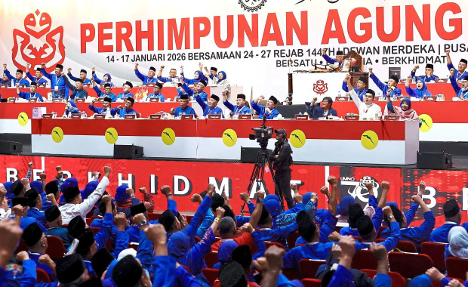
[1] UMNO, once the dominant force in Malaysian politics, concluded its annual general assembly last week. There was plenty of fist-pumping, sloganeering and speeches but little clarity about what the spectacle was meant to achieve. It was assembly for assembly’s sake, heavy on emotion and light on purpose.
[2] Substantive debate was conspicuously absent. The cost-of-living crisis, persistent corruption scandals and the urgent need for institutional reform barely registered. Even Bumiputera empowerment, usually a staple of UMNO discourse, was pushed to the margins. Instead, delegates fixated on a familiar and convenient target: the supposed existential threat posed by the DAP.
[3] The tone had been set even before the assembly began. UMNO Youth chief Dr Akmal Saleh – who has built a political profile on provocation and race-baiting – called on the party to wage a fight to the finish with the DAP, even if it meant exiting the unity government. Delegates eagerly took up the refrain, leaving party president Ahmad Zahid Hamidi and the leadership scrambling to dampen the polemics without appearing overly accommodating towards the DAP.
[4] The irony, of course, is that the DAP has spent the past three years going out of its way to be nice to UMNO, often to the dismay of its own supporters. It accepted UMNO’s disproportionate influence in Cabinet, refrained from challenging sensitive Malay interests, and even disciplined its own MPs for publicly gloating over Najib Razak’s legal setbacks. Some of its leaders have gone so far as to muse about a long-term relationship with UMNO.
[5] For Malay nationalists, however, no amount of accommodation is ever enough. It’s not about policy differences; it’s about racial equations. Like other Malay-based parties, UMNO remains deeply uneasy with any form of genuine power-sharing with non-Malay political parties. When they talk about existential threats, they really mean keeping non-Malay participation in government to a minimum. What they seek is not partnership but subordination. The ideal non-Malay ally, in UMNO’s political imagination, is weak, compliant and grateful – present to confer legitimacy, but never to demand equality.
[6] But joining the unity government which includes the DAP was a strategic necessity for UMNO. It rescued UMNO from the ashes of defeat and turned it into the second most powerful party in government, replete with a deputy premiership and several key ministries. That’s not something to be thrown away just to pander to the gallery.
[7] UMNO now faces a conundrum of its own making. To remain relevant and in a position of power, it must cooperate with the very party it spent decades portraying as a mortal threat to the Malays. Malay grievances, anxieties and even failures were distilled into three letters: DAP (which doubled, conveniently, as shorthand for the Chinese community). In this sense, Akmal serves a useful purpose – some say with the tacit support of the leadership – in keeping the pot of Malay nationalism boiling; Zahid’s job is to make sure – for purely tactical reasons – that it doesn’t spill over.
[8] Zahid’s approach reflects less a coherent ideological vision than a survival strategy. He understands that UMNO, in its current weakened state, cannot afford either nationalist purity or open confrontation. His task is not to resolve the party’s contradictions but to manage them – long enough to rebuild UMNO’s shattered base and restore its bargaining power. That requires appeasing the grassroots with familiar rhetoric while reassuring coalition partners that the noise will not translate into action.
[9] Zahid is not trying to lead UMNO somewhere new. He is trying to keep it afloat. The unity government is not an end in itself but a holding pattern – one that allows UMNO to recover from electoral collapse without suffering marginalization in the opposition. Hence the awkward spectacle on display at the assembly: leaders acknowledging that the DAP has been helpful and cooperative, while simultaneously insisting that UMNO must remain in government to “keep the DAP in check” and hinting that the Malays must always be on guard against who else but the DAP.
[10] Behind the rhetoric lies a high-stakes balancing act as Zahid positions UMNO for GE16: keeping alliances open, floating the mirage of “Malay unity,” shoring up internal cohesion, and avoiding an open rupture with unity government partners. Until UMNO regains confidence in its own strength, it will continue to walk a tightrope: keeping the DAP in its crosshairs while governing alongside it; posturing as the defender of Malay rights while cooperating with a party it claims is a threat to those rights.
[11] For now, this balancing act may be politically necessary. But it is also corrosive. A party that cannot articulate what it stands for, beyond who it stands against, is unlikely to find lasting renewal.
[Dennis Ignatius |Kuala Lumpur | 23 January 2026]
 Dennis Ignatius
You must be logged in to post a comment.