
Tags
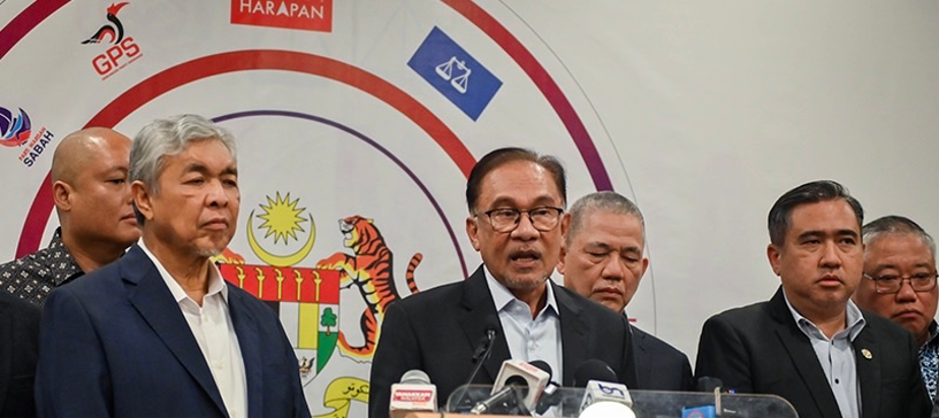
Whichever way you cut it, the results of the August 12 elections were a huge setback for the unity government and for Prime Minister Anwar Ibrahim personally.
Anwar has tried very hard to burnish his Malay-Muslim bona fides – further empowering JAKIM, increasing the salaries of the religious bureaucracy, hosting Islamic events, declining to tinker with either the overwhelmingly monoracial civil service or the university quota system, etc. He also threw billions in special allocations to key Malay-Muslim voter segments including FELDA settlers, and security and civil service personnel.
At the same time, he minimised the profile of the DAP in his cabinet in the hope of undercutting opposition allegations that the DAP is pulling his strings, and shunned some of the promises that long animated his ‘reformasi’ movement.
But everything he has done thus far has not been quite enough to improve his standing among Malay-Muslim voters; he remains – as the voting shows – distrusted by the majority of Malay-Muslim voters. Indeed, one survey put his approval rating among Malay-Muslims at a mere 24%; “no [sitting] prime minister since Merdeka has had less Malay support.”[1]
Anwar’s great hope that UMNO would somehow make up for his own lack of Malay-Muslim support turned out to be terribly misplaced. Zahid – facing multiple corruption charges, leadership issues and anger over his association with the DAP – appears to have lost the confidence not only of his own party but of Malay-Muslim voters as well.
In many ways, of course, Anwar is a victim of history. He inherited a deeply polarised nation that is caught in a tangle of legacy issues. He came to office at a time when religious conservatism was already far advanced, perhaps too far advanced to be reversed. And he took office without a strong mandate of his own.
But he is also a victim of his own folly. He helped sow the seeds of the religious conservatism that is now challenging him. And, having finally won power after decades of struggle and great sacrifice, he seems unsure of what he wants to do with that power. His ‘Madani Malaysia’ vision is just another uninspiring slogan bereft of real substance and without much traction among Malay-Muslim voters.
Clearly, Anwar is now facing unimaginable pressure to quickly win Malay-Muslim support. The general prescription seems to be don’t pander to the Islamists but instead “fix the economy, adopt a moderate political stand and continue to fight corruption and abuse of power”.[2]
There are, however, no easy options to be had. Sound economic policies that would improve the lot of the B40 and M40 groups are, of course, no-brainers. Deferring some of the reforms that Malay-Muslims find contentious (civil service reform, quota system, NEP) might give Anwar some breathing space provided he does not further spook non-Muslims with right-wing policies.
But it is unlikely to be enough to stop or at least slow the green wave given that the key challenge is winning the support of a Malay-Muslim electorate that has become more conservative, one that prioritises religion and race above other factors.
Economic development in itself may not be the panacea that many believe it to be. After all, the whole Ketuanan Melayu-Islam phenomenon derives not from a lack of economic opportunity but rather from decades of religious and political indoctrination.
In other words, while economic and social development is critical to the overall success of the Anwar administration, it is his political response to the Ketuanan Melayu-Islam phenomenon that will determine his fate.
Non-Malays, of course, want Anwar to hold the line on our plural, secular democracy but it is clear that such a construct has already been rejected by a majority of Malay-Muslim voters who want a nation premised upon the Quran and Islamic governance.
Feeble attempts at promoting the Rukun Negara in schools and government institutions and dusting off the history books to highlight the role of independence icons like Tun Dr Ismail – again much needed and long overdue – are unlikely to change mindsets in the short-term; and the short-term is all that Anwar might have.
Anwar is therefore caught on the horns of an immense dilemma. If he panders to conservative Malay-Muslim voters, he will quickly lose vital non-Malay support. On the other hand, the more he tries to defend multiculturalism, the more he will lose Malay-Muslim support.
Anwar the reformist (if he’s still out there somewhere) might want to champion an inclusive, multicultural polity but Anwar the Islamist politician of yore will likely be tempted to try to beat PAS at its own game.
Indeed, Education Minister Fadhlina Sidek’s recent announcement concerning the introduction of an ‘Imam Al-Nawawi’s 40 Hadith’ module in all government schools[3] might mark the beginning of a new offensive to up the ante vis-à-vis PAS.
If history is anything to go by, however, such measures are unlikely to save his government. All it will do is hasten the slide towards an Islamic state.
[Dennis Ignatius | Kuala Lumpur | 23rd August 2023]
[1] What stability without majority Malay support, PN asks Anwar | Malaysia Now |22 August 2023
[2] Anwar must address trust deficit to regain Malay votes, say experts | The Malaysian Insight | 22 August 2023
[3] Fadhlina: Education Ministry launches ‘Imam Al-Nawawi’s 40 Hadith’ appreciation module | Malay Mail |19 August 2023
 Dennis Ignatius
You must be logged in to post a comment.